


The Construction of AIDAprima in Timelapse
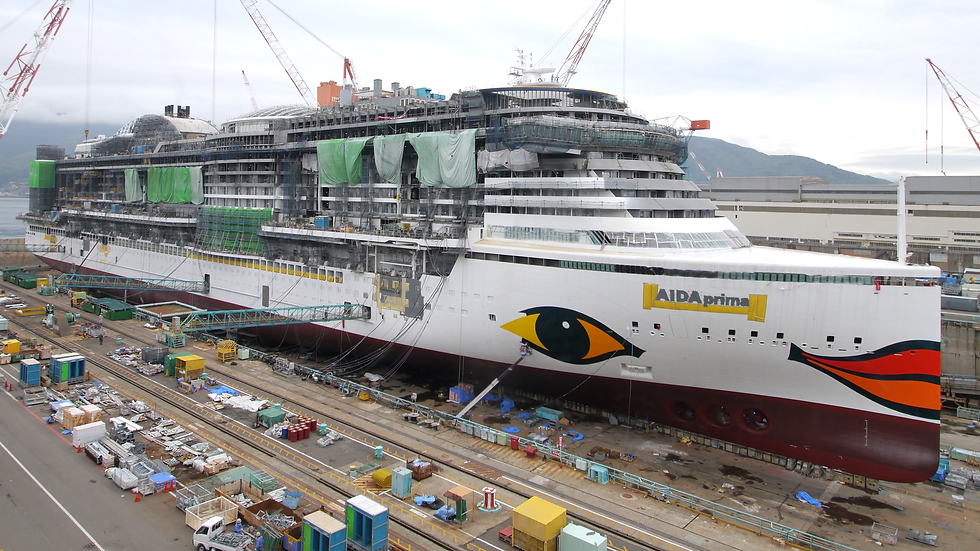
Shipbuilding Timelapse of a Cruise Giant – How the AIDAprima Is Built
About the Project
With the AIDAprima, AIDA Cruises embarked on an entirely new generation of cruise ships. From the very beginning, the project was highly ambitious: a vessel designed to be more modern, more efficient, and more comfortable than anything the cruise line had operated before. The vision encompassed not only a new architectural concept but also far-reaching innovations in shipbuilding, including advanced energy and environmental systems, an optimized hull design, and a concept aimed at redefining the guest experience at sea.

The AIDAprima was built at the Mitsubishi Heavy Industries shipyard in Nagasaki, a location with decades of experience in large-scale shipbuilding. For the AIDA fleet, this project marked an important milestone: it was both the starting point for an entirely new class of ships and the first time an AIDA ship was constructed in Japan.
The construction of the AIDAprima quickly became one of the most technically complex projects that Mitsubishi and AIDA had ever undertaken. The ship’s size, the multitude of new technologies, and the high standards for sustainability made this project a true engineering challenge.
Construction and Challenges of the AIDAprima
The AIDAprima was constructed at the Mitsubishi Heavy Industries shipyard in Nagasaki, one of Japan’s most advanced shipyards. Construction began with the keel laying in 2012, followed by the assembly of the individual sections of the ship’s hull. Due to the size and complexity of the cruise ship, hundreds of modules had to be joined in a confined space, a logistical masterpiece in shipbuilding.

As with many large-scale projects, challenges arose that the teams at Mitsubishi and AIDA had to resolve. The delivery of the ship was delayed several times, due in part to technical adjustments and strict safety inspections, before the AIDAprima finally embarked on its maiden voyage in 2016.
The cruise ship impresses not only with its length of over 300 meters and a capacity of more than 3,000 passengers, but also with the innovative design of public areas, cabins, and leisure facilities, setting new standards for the entire AIDA fleet.
For AIDA, the AIDAprima marked the beginning of a new era. It laid the foundation for subsequent ships of the same class, including the AIDAcosma and AIDAnova, which build upon the experiences of this project.

Our Mission in the Shipyard
For MK Timelapse, the construction of the AIDAprima was not only an extraordinary project but also a major technical testing ground. It was our first project in Japan, our first shipbuilding project for AIDA, and one of the largest setups we had implemented up to that point.
As early as 2012, our team traveled to Nagasaki to oversee the installation of the timelapse cameras directly at the dry dock. We placed three cameras at three strategic positions to capture the construction of the AIDAprima. Our systems at the time were the MK V.2 units with 16 megapixels, which may seem nostalgic today but were among the most powerful long-term timelapse systems available back then.
When the AIDAprima arrived in Hamburg for its christening in 2016, the project shifted from a calm long-term documentation to live event coverage. Our team of three operated from three positions around the harbor. Excitingly, around this time we had upgraded our camera technology, allowing the christening to be captured at 40 megapixels.
For the final documentation, we relied on different perspectives:
HTC Tower: two cameras for the entry and an overview of the harbor
Landungsbrücken: wide shot of the ship and fireworks
Fischmarkt: additional perspective including the later departure
The combination of long-term installed systems in Japan, the complete upgrade during the ongoing process, and precisely planned mobile setups in Hamburg made this timelapse documentation one of the most comprehensive and dynamic projects we had accomplished up to that point.
Systems
3x MK V.2
Resolution
16 Megapixels (up to 40 Megapixels in Hamburg)
Interval
1 Picture per Minute / 10 Second Intervals for Mobile Setup
Highlights
Project Across Multiple Continents (Nagasaki & Hamburg)
From Japan to Hamburg
Not only during the construction, but also at the christening of the AIDAprima in Hamburg, MK Timelapse was there live. With a total of four cameras at three positions, we were able to document the entire ceremony and the ship’s journey through the harbor.
Our footage captures the impressive light show and the final fireworks, which bathed the Hamburg harbor in spectacular colors. Thanks to the different camera perspectives, we were able to capture both panoramic views of the harbor and detailed shots of the ship and the celebrations.
After completion in Nagasaki, Japan, the AIDAprima returned to our hometown Hamburg. For us, it was a particularly rewarding project conclusion, bringing the entire construction process, from keel laying in distant Japan to the christening on our doorstep—full circle.
A Milestone
The timelapse documentation of the AIDAprima’s construction was a truly extraordinary project for MK Timelapse in both scale and scope. For the first time, we were able to follow the construction of a cruise ship from start to finish, providing a continuous view of every step of this impressive shipbuilding project.
Our 2016 timelapse film is therefore also the first of its kind in this quality to show the construction of a cruise ship without interruption.
Bau der AIDAprima
The finished film has surpassed 20 million views on our YouTube channel, making it one of the most successful construction timelapses ever. From the keel laying to the christening, our footage provides a continuous visual record of this outstanding shipbuilding project and marks an important milestone in our work.
🎬 Watch Now: https://youtu.be/lavm7CausyA?si=tAF34hk-n4WgKRIZ
More about our technology: https://www.zeitraffer.org/baustellenkamera


Comments